Latest UI UX Design Job Openings: Explore Career Opportunities in UI/UX Design
The demand for skilled UI UX designers continues to create career opportunities across technology companies, startups, digital agencies, SaaS businesses, e-commerce brands and product companies. For aspiring designers, UI UX Design Job Openings portals such as Naukri provide an easy way to explore current openings for roles including UI Designer, UX Designer, Product Designer and UX/UI Designer.
If you search for “UI UX Designer jobs” on Naukri, you can find opportunities across different experience levels and locations. However, getting shortlisted for these positions requires more than knowing a design tool. Employers increasingly look for candidates who can demonstrate their design thinking, problem-solving ability, portfolio quality and understanding of real-world user experiences. This is where structured UI/UX training and practical project experience can make a difference.
Latest UI UX design job openings in India include opportunities for UI/UX Designers, UX Designers, Product Designers, UI Designers, and UI/UX Design Interns. Current listings show demand for skills such as Figma, wireframing, prototyping, user research, design systems, and creating high-fidelity interfaces. Both startups and established companies are hiring across different experience levels, making portfolio projects and practical design skills important for candidates looking to enter or grow in the UI/UX field.
Latest UI UX design job openings in Mumbai include roles such as UI/UX Designer, UX Designer, Product Designer, and UI Designer.
Companies are looking for skills in Figma, wireframing, prototyping, user research, design systems, and high-fidelity interface design.
Freshers and experienced designers can explore opportunities across startups, agencies, and established companies. A strong portfolio and practical project experience can help candidates prepare for these roles.
Explore Current UI UX Design Job openings Opportunities
UI UX professionals can find openings across several job roles, including:
UI/UX & UX/UI Designer
Balances user needs and business objectives to create end-to-end digital experiences from initial concept to launch.
UI & Visual Designer
Focuses on visual interfaces, color theory, typography, component libraries, and visual consistency across screens.
UX Designer & Researcher
Studies user behavior, maps customer journeys, conducts usability tests, and builds information architecture.
Product & Interaction Designer
Focuses on product experience, business goals, user interactions, navigation, and seamless micro-animations.
Job requirements vary from company to company. Some openings are designed for freshers or junior designers, while others require professional experience and a strong portfolio. Candidates searching for UI UX Design Job Openings on Naukri should therefore pay attention not only to the job title but also to the skills, experience requirements, tools and portfolio expectations mentioned in each vacancy.
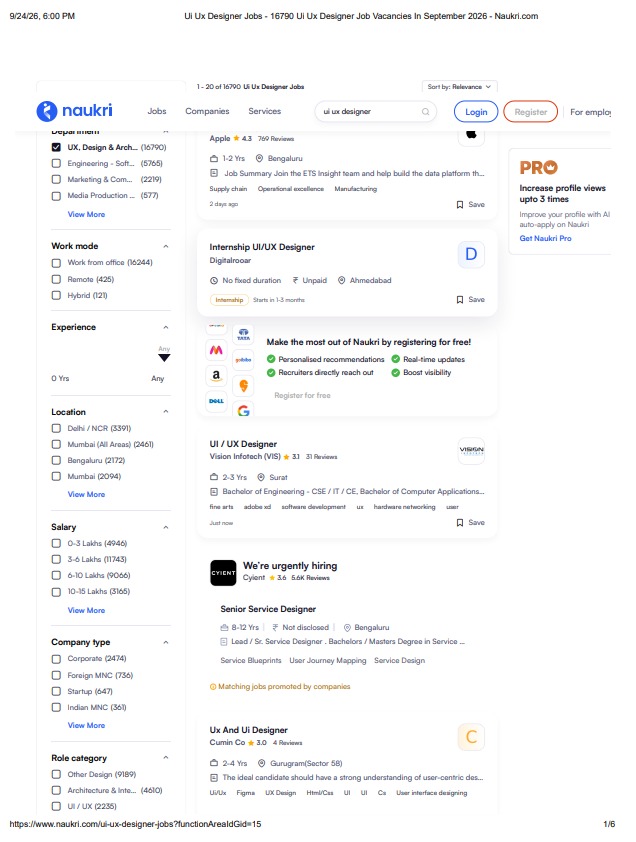
Current Naukri UI UX Design Job Openings Search Results showcasing active opportunities across companies.
Looking to enter the UI/UX job market?
Enquire today to explore upcoming batch schedules and curriculum details.
What Do Employers Look for in UI/UX Designers?
A UI UX Design Job Openings description can include a combination of design, research and problem-solving skills. Depending on the role, employers may look for experience with:
Learning these skills individually is useful, but applying them to real projects is equally important. A portfolio allows recruiters to understand how a designer approaches a problem, develops ideas, makes design decisions and improves the final experience.
Why a UI/UX Portfolio Matters for Job Applications
When applying for UI/UX positions, your portfolio can be one of the most important ways to demonstrate your capabilities. Instead of simply showing attractive screens, a strong portfolio should explain the design process. For example, a case study can demonstrate:
The Proven Case Study Structure for Recruiters
Problem → Research → User Insights → Ideation → Wireframes → Prototype → Testing → Final Design
This gives recruiters a better understanding of the candidate's problem-solving approach. At EDIT Institute, practical projects, portfolio development, mentor feedback and interview preparation are part of the learning experience. EDIT states that its UI/UX program includes project-based portfolio preparation and individual placement support.
From Learning UI/UX to Becoming Job-Ready
Learning Figma or another design tool is only one part of becoming a UI/UX designer. A job-ready candidate needs to combine:
Design Skills + UX Thinking + Practical Projects + Portfolio + Communication + Interview Preparation
This is the approach that can help students move from simply learning design tools to presenting themselves as professional designers. EDIT Institute's current UI/UX course information highlights practical learning, real-world projects, portfolio development, AI-assisted workflows and placement assistance.
Want expert guidance on building your portfolio?
Speak with an EDIT design advisor to learn how to showcase your case studies effectively.
EDIT Student Experiences: Learning Through Practical Projects
Student experiences published on EDIT's official testimonial page also highlight the importance of practical learning and career preparation:
| Student Name | Background | Placed Role & Company | Key Learning Highlight |
|---|---|---|---|
| Ashwini Wagh | BE IT | UI/UX Designer at Decimal Point Analytics | Portfolio & Interviews |
| Rohan Deepak Jamdar | B.Sc. Computer Science | UX/UI Designer at Accenture | Resume & Mentorship |
| Prathmesh Prakash Patil | B.Com | UX UI Designer at Terado Engineering | Real Case Studies |
"The course provided practical skills and industry knowledge. Portfolio building, instructor feedback, mock interviews and placement support made all the difference in my transition."
"Resume guidance, portfolio creation and interview preparation were extremely useful parts of my learning experience at EDIT Institute."
Another student, Prathmesh Prakash Patil, credited hands-on projects and real-world case studies with helping him build his portfolio and confidence before joining Terado Engineering as a UX UI Designer. These testimonials illustrate a common theme: UI/UX career preparation involves more than software training. Students need opportunities to practise, create projects, develop portfolios and prepare for interviews.
UI/UX Career Opportunities After Professional Training
A structured UI/UX program can prepare learners for different career paths:
- UI Designer: UI Designers focus on the visual interface of websites and applications, including typography, colour, layouts, components and visual consistency.
- UX Designer: UX Designers focus on understanding users and creating experiences that are intuitive, useful and easy to navigate.
- Product Designer: Product Designers work across UX and UI while considering business objectives, user needs and the overall product experience.
- Interaction Designer: Interaction Designers focus on how users interact with digital products, including navigation, transitions, interactions and usability.
- UX Researcher: UX Researchers study user behaviour, needs and feedback to help teams make informed design decisions.
How EDIT Helps Students Prepare for UI UX Design Job Openings
EDIT Institute's UI/UX program is designed around practical learning rather than software training alone. According to EDIT's current course information, the program includes:
- Industry-focused UI/UX curriculum
- Practical projects and real-world case studies
- Portfolio preparation and mentor guidance
- Mock interview preparation and resume guidance
- Individual placement assistance
- AI-assisted design workflows
- Training in industry tools such as Figma, FigJam, Miro and Maze
EDIT also states that more than 5,000 UI/UX designers have completed its course in the last three years and that more than 500 companies have recruited its students during that period. These are institute-reported figures and should be considered in that context.
Preparing for UI/UX Jobs on Naukri
If you are actively searching for UI UX Design Job Openings on Naukri, use a structured approach:
- Create a Strong Profile: Make sure your profile clearly communicates your UI/UX skills, tools, education and relevant project experience.
- Build a Portfolio: Include 3–5 strong projects rather than simply uploading many screens.
- Show Your Design Process: Explain the problem, research, design decisions and final solution.
- Match Your Resume With the UI UX Design Job Openings Description: If a job requires Figma, prototyping, design systems or user research, make sure your relevant experience is clearly visible.
- Prepare for Design Interviews: Be ready to explain your design decisions rather than only showing the final screens.
- Apply Consistently: UI UX careers can require multiple applications and interviews before finding the right opportunity. Use UI UX Design Job Openings portals, company career pages, professional networks and institute placement opportunities together.
Ready to accelerate your job search?
Get personalized guidance on resume building, portfolio reviews, and interview prep.
Build Skills Today for Tomorrow's UI UX Design Job Openings
The growing number of UI UX Design Job Openings listings gives aspiring designers multiple paths into the digital design industry. But the competition for these roles means candidates need more than a certificate. A strong combination of UX fundamentals, UI design, practical projects, portfolio development and interview preparation can help candidates present themselves more effectively to employers.
At EDIT Institute, students learn through practical assignments and projects while receiving guidance on portfolio development and placement preparation. Student testimonials published by EDIT also describe experiences involving practical learning, portfolio building, interview preparation and placement assistance.
If your goal is to become a UI UX Designer, start by exploring current vacancies, identify the skills employers are asking for, and then build those skills through practical projects. Your next UI/UX opportunity could start with the skills you build today.